


Kilo Whiskey · Concept study · Grid resilience · Munich
BACKSTOPA limit that cannot be updated away
- Europe's grid takes instructions from clouds it does not control.
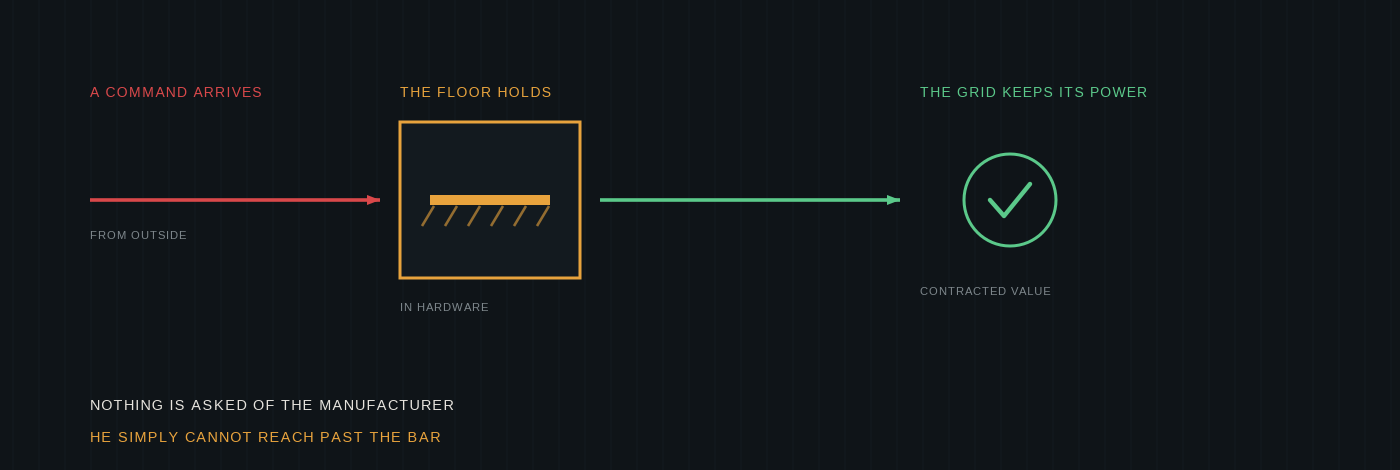
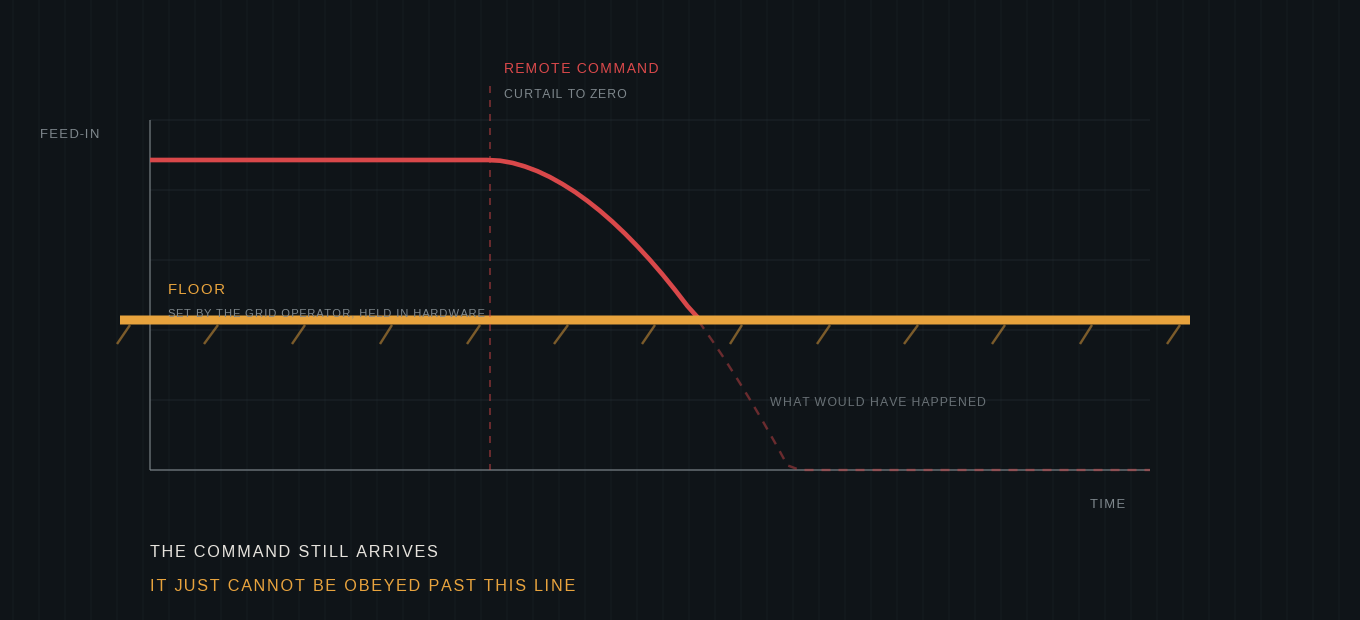
- We put a floor under the feed-in, in hardware, set by the grid operator.
- The command still arrives. It just cannot be obeyed past that line.
-
01
The command arrives
From a manufacturer platform, often outside the Union. Nobody blocks it, and nobody needs to.
-
02
The floor holds
A value the grid operator set, enforced by a circuit — not by a setting a firmware update can change.
-
03
The grid keeps its power
Down to the contracted value and no further. What was promised to the network stays on the network.
01 The problem
The switch is real. It is just not in Europe.
Solar has been built out faster than anything else on the continent: more than 128 GWp and over six million installations in Germany alone, and according to the Federal Government 70 to 80 per cent of Europe's PV inverters come from Chinese manufacturers. The boxes that connect all of this to the grid are almost all remotely managed. That was a service feature. At today's installed scale it is something else.
-
01
The convenience became the exposure
Remote firmware and remote configuration were sold as maintenance. They are the reason a single operator can change the behaviour of an entire fleet without touching a roof, and the reason nobody local can stop it.
-
02
The danger is simultaneity, not sabotage
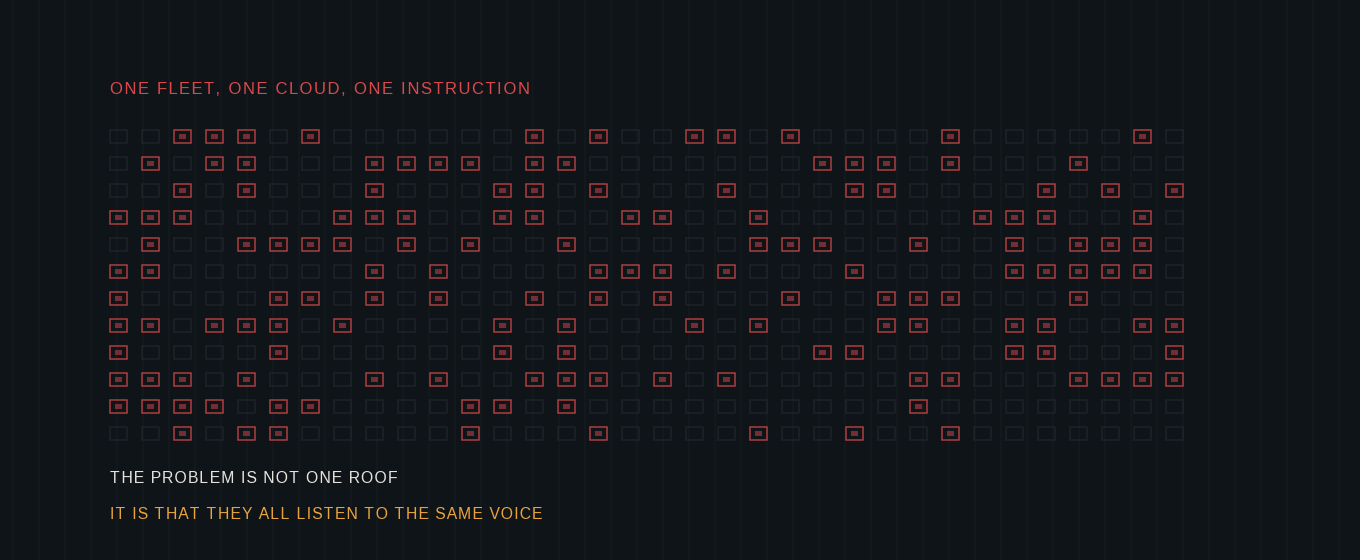
One inverter dropping out is a service call. Every inverter of one make dropping out inside the same second is a frequency event. Grids are engineered for the loss of a large plant, not for the coordinated loss of a diffuse one.
-
03
Nobody in the chain can act alone
The homeowner cannot audit firmware. The installer has no leverage. The grid operator has no contract with the manufacturer. The manufacturer has no obligation to give up an access that his warranty depends on. Everyone is reasonable and the gap stays open.
-
04
Replacing the hardware is not an option
The units are installed, financed and warranted, and Europe does not have the manufacturing base to swap them at that volume. Any answer that begins with "buy European inverters instead" is an answer for the next decade, not for this one.


Sources: Solarserver / BSW on 128 GWp; pv magazine on the Federal Government's answer, 29 June 2026; innobu on manufacturer groups above 10 GW (secondary source); SolarPower Europe and DNV on the 3 GW threshold.
01a What happened in August 2026
One login. 470,000 plants. Patched in three days.
In August 2026 a security researcher found that a single parameter in the login of a major manufacturer's cloud platform granted access without a password, up to administrator accounts, on all four regional servers. The manufacturer patched it within three days. Nothing was switched off. But for the first time the structure this page describes had a number attached to it.
≈ 470,000
plants in Europe on the affected platform, about 250,000 of them in Germany
Die Zeit via Cleanthinking · 7 Oct 2026
7.8 GW
peak capacity of the affected plants in Germany
Die Zeit via Cleanthinking · 7 Oct 2026
17.59 / 3
GW real-time output shown on the European panel at the end of August, against the 3 GW loss the grid is dimensioned for
Screenshot reported by Die Zeit · SolarPower Europe / DNV
66,000+
solar energy systems exposed on the internet worldwide, at least 10,000 with known vulnerabilities
arXiv 2609.07783 · Sep 2026
7,942
externally reachable systems in European solar and wind parks — a lower bound
Modat and NCSC-NL via PV Tech · Oct 2026
2027
earliest date for binding NIS-2 rules in the energy sector, according to the regulator; until then protection is voluntary
ZfK · 8 Oct 2026
22 Aug 2026
Reported
A researcher reports passwordless access to the manufacturer's cloud, up to admin accounts.
25 Aug 2026
Patched
Emergency patch. According to the manufacturer and the BSI there is no sign of exploitation.
7 Oct 2026
Public
Die Zeit publishes. The manufacturer says critical settings needed a second password; the researcher says it could be reset.
16 Oct 2026
BSI-CS 154
The BSI advises checking whether a manufacturer cloud is needed at all and running PV plants purely locally where possible.
Sources: Cleanthinking on the Die Zeit investigation; hessenschau with Fraunhofer and BSI; PV Tech on the manufacturer's statement; ZfK on classification and NIS-2; pv magazine on BSI-CS 154; arXiv 2609.07783; PV Tech on exposed parks.
02 The module
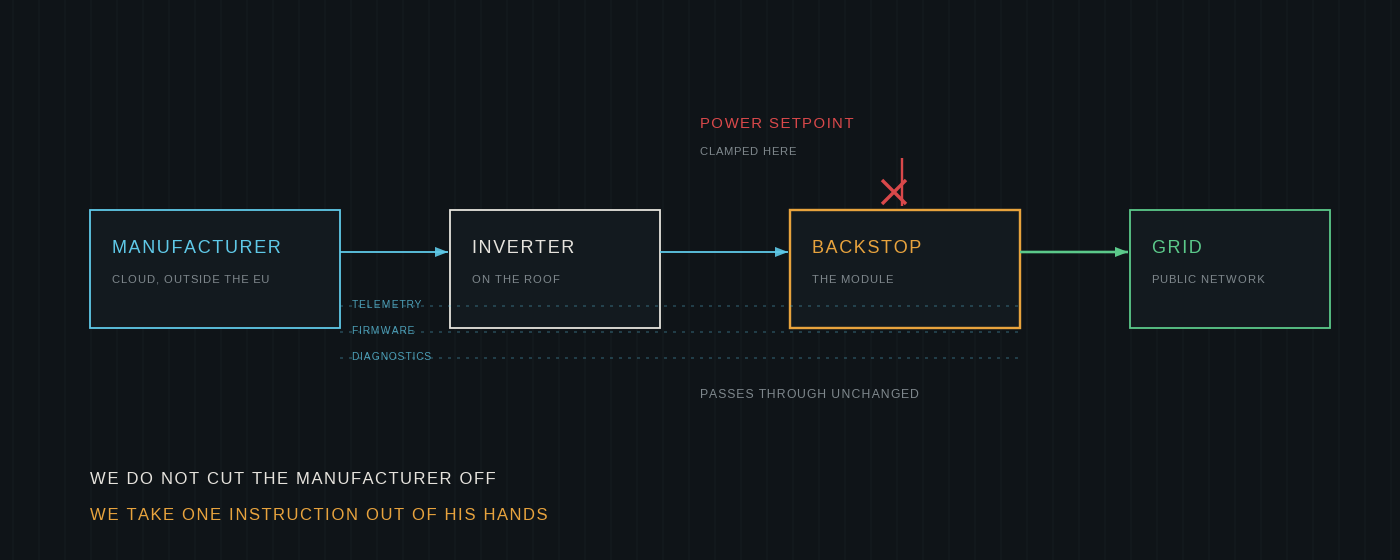
We do not cut the manufacturer off. We take one instruction out of his hands.
A small unit installed between the inverter and the connection point. It is deliberately dumb, deliberately offline, and deliberately impossible to reconfigure from anywhere except in front of it.

-
01
It has no network
No cloud, no SIM, no update channel. A module with a remote management interface would simply move the problem from one manufacturer to another — namely to us. The United States drew the same line in July 2026: its restriction on foreign-produced inverters covers networked units; air-gapped devices fall outside it.
-
02
It fails to the promise, not to zero
If the module itself dies, the plant continues at the contracted value. A safety device that creates the outage it was bought to prevent is not a safety device.
-
03
It is not a firewall
Deep packet inspection between a cloud and an inverter is a losing race against protocol changes. A bounded electrical quantity does not care what protocol the instruction arrived in.
-
04
It is the same idea we have used before
Enforce the limit in the physics rather than assert it in the software. It is why a release authority belongs in a switch, and it is why a grid floor belongs in a circuit.
03 What the law already says
Europe is acting on suppliers and on new products. The installed base is nobody's.
Since spring 2026 the measures have come quickly: a funding stop, a high-risk vendor list in preparation, an expert group, a national review. Every one of them changes what will be bought next. None of them limits what a unit already on a roof does on command tomorrow morning.
How to read this section
- Verified We read the instrument itself.
- Reported Named and credible, primary text unchecked.
- Our reading Our interpretation, argued and not measured.
Nothing on this page is presented as more settled than it is. A concept that sells provenance of control has to be honest about the provenance of its own claims.
-
01
The Cyber Resilience Act reaches new products from December 2027 Reported
Product obligations apply to devices placed on the market from 11 December 2027. Inverters are not classified as critical products today; the Commission's expert group recommended on 8 October 2026 that they become Class II. Either way, the units already installed are outside its reach — and they are the exposure.
-
02
NIS-2 puts the duty on the operator, from 2027 at the earliest Reported
The German implementation has been in force since December 2025, but the regulator expects binding energy-sector requirements no earlier than 2027, and single inverters fall below every threshold. The BSI and the Federal Network Agency call such cloud platforms potentially system-critical; protection remains voluntary in the meantime.
-
03
Supplier exclusion is the chosen instrument Reported
EU and EIB funds no longer go to projects with inverters from China, Russia, Iran or North Korea. A revision of the Cybersecurity Act with a high-risk vendor list has been in procedure since January 2026, and the Federal Government is examining a ban on critical components under § 41 BSIG. All three act on the next purchase. Replacing over 200 GW already connected is not on anyone's timetable.
-
04
Lithuania shows the installed base can be addressed Reported
Since 1 May 2025 Chinese companies may not have remote access to solar, wind and storage installations above 100 kW. It is not a device ban: existing operators have to add safeguards. That is the regulatory shape a retrofit instrument fits into.
-
05
The authorities now recommend local operation Reported
BSI-CS 154 of October 2026 asks operators of PV plants of every size to check whether a manufacturer cloud is needed permanently and to run plants purely locally where possible. The EU expert group recommends blocking inbound connections to large parks and manual firmware updates for commercial plants. BACKSTOP turns that advice into hardware for the one quantity that matters to the grid.
-
06
The question we said we would answer Checked so far
Does the German smart meter gateway and its control box already bound a manufacturer's cloud setpoint? Public sources say no: cloud control means "in every case a bypass of the smart meter gateway and the control box" (pv magazine, December 2025). The Federal Network Agency's rule that grid-relevant control runs only through the gateway is a rule, not a technical barrier, and the FNN control box acts at the connection point without addressing manufacturer clouds. We have not found any authoritative statement to the contrary, and we are still asking for one.
Sources: pv magazine on the EU expert group; ZfK; ORF on the funding stop; pv magazine on the Cybersecurity Act revision; pv magazine on § 41 BSIG; LRT on Lithuania; pv magazine on BSI-CS 154; pv magazine on the gateway bypass; VDE FNN on control of generating plants; pv magazine USA on the FCC restriction.
04 Who buys it
Not millions of households. A few hundred organisations.
The exposure is diffuse but the obligation is concentrated, and that is what makes this sellable at all.
-
01
Distribution grid operators
They carry the frequency and they carry the duty. They already buy secondary technology per substation and they already have an approval process for it.
-
02
Large plant operators and aggregators
Anyone marketing pooled capacity has sold a promise of availability. A remote curtailment they cannot refuse is a commercial risk before it is a political one.
-
03
Sites that cannot be dark
Hospitals, water works, data centres, airfields. They buy resilience already, and they buy it as hardware, and they do not need to be persuaded that a supplier can be a risk.
-
04
The state as an anchor customer
Where sovereignty over the grid becomes a stated objective, a bounded control path is a cheaper instrument than a ban and a faster one than reindustrialisation.


05 Market environment
Everyone is watching the door. Nobody is fitting a bolt.
Since the August case the adjacent categories have moved quickly, and one of them has come close. None of them ends with a physical limit at the connection point.
Nearest — communication filters
Edge gateways at the meter
A German spin-off offered a gateway in February 2026 that separates the plant from the manufacturer cloud and passes only authenticated commands. It is the closest neighbour, and it is still a filter: it has to understand every protocol and every update, and it is itself a networked device.
Adjacent — OT security
Routers, segmentation, monitoring
Industrial suppliers sell security routers and segmentation for PV parks, and OT platforms see the traffic. Seeing a curtailment command arrive is not the same as being unable to be curtailed.
Adjacent — substitution
Supplier exclusion and European inverters
The right answer over fifteen years, and it has a price: western inverters add an estimated 1.7 to 4.3 per cent to project cost. It is not an answer for the installed base, and the installed base is the exposure.
Where the demand comes from
The industry asked for this layer before the August case. In April 2025 SolarPower Europe and DNV warned that an attack on 3 GW of inverter capacity would have serious consequences, and DNV called for a trusted intermediate security layer between manufacturer and grid.
Data location does not close the command path. A European manufacturer's security chief put it plainly in 2026: European servers do not limit access; the manufacturer always keeps master access. Whoever holds that access, wherever he sits, holds the instruction BACKSTOP bounds.
The physical bound is still unoccupied. Our research up to 22 October 2026 found no device that limits the effect of a manufacturer command to a corridor set by the grid operator. That is a finding from public sources, not proof of absence.
Sources: pv magazine on the Solarsecure gateway (mirror); Weidmüller company release; EU Perspectives citing Wood Mackenzie; PV Tech on SolarPower Europe and DNV; pv Europe interview with Fronius.
06 White space
The unoccupied position is the boring one.
A device with no intelligence, no connection and one job, sold to an organisation that already knows how to install secondary technology and already carries the liability. It is unglamorous, which is why it is still free.
- 01
Physical, therefore auditable
An auditor can measure a floor. Nobody can measure a policy.
- 02
Retrofit, therefore immediate
It works on what is already on the roof, which is the only population that matters.
- 03
Neutral, therefore sellable
It accuses no manufacturer of anything. It simply removes a capability that no supplier should hold over a European grid, wherever he sits.
- 04
Small, therefore fundable
One board, one enclosure, one approval. This is a hardware company that a European fund can actually finance.
07 What would kill this
Three findings would end the concept. Here is where each one stands.
Published before anyone asks, because a concept that hides its failure conditions is not a concept, it is a pitch. Status as of 22 October 2026.
-
01
The control box already does it Not found so far
If the existing metering and control infrastructure can already bound a manufacturer setpoint, the product is redundant in its home market and the concept stops here. Public sources say the cloud path bypasses it, and the "smart meter light" now planned for the rest of the market has no control channel at all. Only 26.1 per cent of mandatory metering points had a smart meter in mid-2026.
-
02
Nobody owns the risk Open
If grid operators regard remote manufacturer access as the plant owner's problem, and plant owners regard it as the manufacturer's, then there is no budget line and no buyer, however real the exposure. The risk now has a name from the BSI and the regulator; a budget line does not exist yet, and until 2027 protection is voluntary. This is the one we are working on.
-
03
The exposure is smaller than assumed Not the case
If the genuinely remote-controllable share turned out to be modest, or fragmented across enough platforms that no single instruction reaches a system-relevant volume, the argument would lose its severity. One platform alone reached 7.8 GW in Germany and showed 17.59 GW of live output in Europe, against a 3 GW reference loss. A total for all platforms has still not been published.
This page states a thesis, not a finding. Figures are published with their sources and the date they were checked — including any that contradict what is written above. Sources for this section: Cleanthinking on the FfE smart meter study; ZfK on smart meter light; Cleanthinking on the platform figures.
08 Team
Concept stage, in the open.
Kilo Whiskey is one of a family of concepts built on a single conviction: where a legal limit matters, it should be enforced by physics and not asserted by software. The same idea sits under a weapons release gate, a directed-energy aperture and a supply-chain record.
Concept and business development: Arne Eilers, formerly COO, de:hub Security & Defense (BMWE). Looking for: a power electronics engineer who has taken a device through grid connection approval, and a distribution grid operator willing to argue with this page.
09 Contact
Tell us where this is wrong
For grid operators, plant operators, regulators, power electronics engineers and investors. A correction is worth more to us than an introduction.
Concept stage · English or German · Munich, European Union